The Last Men’s engagement with the human past
Last and First MenThe Last Men’s engagement with the human past is both a new power and a chosen obligation: they can contribute to certain minds in the past without changing the events those minds inhabit, and they seek to know and love the human past in its full particularity. Their contact with earlier minds gives them more than historical knowledge. It becomes a source of affection, a way of discerning beauty in humanity’s long, troubled career, and, in their final crisis, a means of recovering the resolve needed to preserve life beyond their own world.
The discovery of influence across time
The Last Men had long been able to enter past minds and share their experience, but at first they were only spectators. Their historians and psychologists sometimes encountered points in an earlier person’s thought that ordinary psychological explanation could not account for. In some cases, they eventually recognized that these apparent gaps corresponded to thoughts or desires in the mind of a present-day observer. Their investigations disclosed that a present mind could contribute to the course of a past mind—not by revising the past, but by participating in features of it that were already what they eternally were.
This power is sharply limited by the past individual’s own experience. An idea that has no meaning for that person cannot simply be inserted into their mind. New ideas and values must be conveyed through familiar material arranged so that it acquires a new significance. The Last Men therefore understand their influence as contribution rather than correction: they cannot make history other than it was, but in certain rare cases their own thoughts help constitute what a past mental event was.
Their account further dissolves the apparent choice between influencing the past and choosing not to do so. Where a past mind depends on their influence, the Last Men argue, there is no possible alternative in which they withhold it: the free choice occurs in eternal being, where they meet the past mind. The same choice belongs to their present age and, in that sense, also to the past. The theory preserves the irrevocability of events while describing a reciprocal relation between minds widely separated in time.
Methods and limits of communication
The Last Men distinguish two ways of reaching earlier people. With minds of great originality and power, they can suggest only a vague intuition. The historical individual then works that intuition into a form of their own, often very different from what the Last Men intended, but capable of becoming potent within that age’s culture. With an average individual whose circumstances suit the purpose, they can communicate more detailed ideas; that person, however, cannot transform the material into a comparably powerful cultural form. The method therefore changes with the recipient: originality allows a suggestion to be remade, while an ordinary mind can carry greater detail without giving it the same force.
What the Last Men hope to contribute are intuitions of truth and value that unaided people of the past might otherwise have missed. They aim to direct attention toward truths and beauties already implicit in earlier people’s experience, rather than to impose an alien world of ideas upon it. Their historical intervention is thus presented as a form of assistance attentive to the recipient’s own limits and possibilities.
The first attempts did not always meet that standard. The Last Men attribute some past cultures’ seemingly nonsensical reports of influence by spirits, deities, fiends, or the dead to gibberish produced by their own inexperienced experiments. They also disclose that the book itself, admirable in their conception, emerged from the brain of a contemporary writer in a largely disordered form. The work’s imperfect transmission is therefore not incidental to its account: the Last Men’s power can leave traces in the past without ensuring that those traces arrive intact or are understood as intended.
The past as archive and inheritance
The book’s histories show why entering past minds matters in a species whose material records and inherited accounts repeatedly disappear or change meaning. After the First World State collapsed, later generations engraved the Swastika on crude pebble tools. The emblem had begun as an image of an aeroplane diving to destruction and had signified the downfall of Gordelpus and the State; subsequent people recast it as the sign of a divine ancestor and a remembrance of a lost golden age. A surviving mark could preserve a trace of the past while its meaning was transformed by the needs and beliefs of those who inherited it.
The Patagonians encountered a more substantial archive when archaeologists found durable metal printing plates in the basement of a shattered pylon in China. The plates had once served as printing blocks, and other finds enabled scholars to decipher the dead language over the following three centuries. This recovered history overturned the Patagonians’ belief that they were pioneers of the mind: they learned that earlier people had built and lost a far greater civilization, and that the ancient past contained both brilliance and madness. The findings divided them between those who rejected the new learning as a lie and those who sought to face and use it.
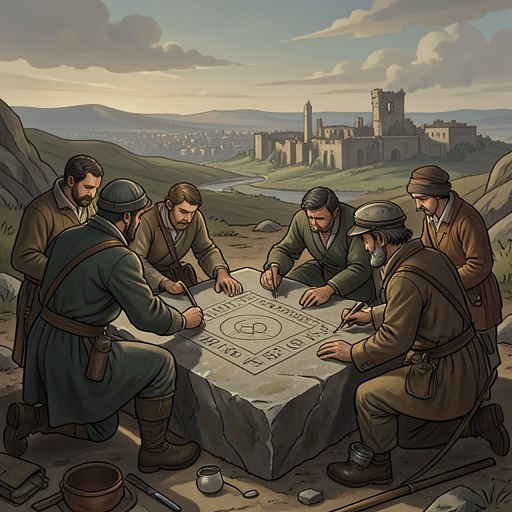
The Second Men’s discovery of the Siberian Stone Library offers a different kind of recovery. Engineers came upon its broken, disordered, weathered tablets while preparing to sink a shaft for subterranean energy. Reconstructed with help from a pictorial dictionary, the tablets interested the Second Men chiefly as historical evidence of the earlier species, not as a source of scientific or philosophical truth. One record preserved much of the sacred text of the Life of the Divine Boy, including the prophet’s final words. The Second Men recognized in those words an intuition familiar to their own experience, an understanding earlier generations had encountered but associated with morbid mentality. Across these histories, recovery does not simply restore a stable inheritance: the same past may be lost, misconstrued, tested, and newly understood.
Love, understanding, and tragic history
Historical knowledge becomes an ethical commitment for the Last Men. They describe their effort to know the human past in every detail as an act of filial piety: when one being comes to know and love another, that love itself creates something new and beautiful, enhancing the cosmos. Their aim is to understand every past mind they can enter, including the least and the worst, and to leave none outside this work of understanding and admiration. The past is not valuable only because it explains the present or supplies useful ideas; its individual lives deserve attention in their own right.
That attention also shapes their interpretation of humanity as a whole. They regard the course of human beings across successive planetary homes as imperfect but beautiful, with the beauty of tragic art. Because that beauty depends in part on the Last Men’s operation at particular points in the past, they choose to act there. Their interventions accordingly have two motives: love for particular minds encountered from within, and a deliberate wish to participate in the larger pattern of human history.
The past and the final work of life
The Last Men’s engagement with history becomes most urgent because their own society is under pressure to undertake an arduous task. They must design an artificial human seed, produce it in immense quantities, and project it among the stars. The work requires a prolonged program of physical research and a world-wide system of manufacture; it will continue until their physical constitution is already being undermined and their community has begun to disintegrate. The Last Men admit that, as artists and philosophers, they would rather devote their remaining time to their culture and to exploring the past. Yet the seed-sowing project cannot be fulfilled without a conviction strong enough to keep them working toward it.
The past supplies that conviction. The Last Men, who have achieved what they call ecstatic fatalism, return to earlier human ventures to learn again the opposed but necessary loyalty to life struggling against death. Their encounters with the past restore a primitive zeal: they can return to their own endangered society with inward peace intact while struggling as if victory alone mattered. Historical understanding thus does not lead them away from action. It renews their willingness to act, even when they are reconciled to the prospect that their own human story will end.